
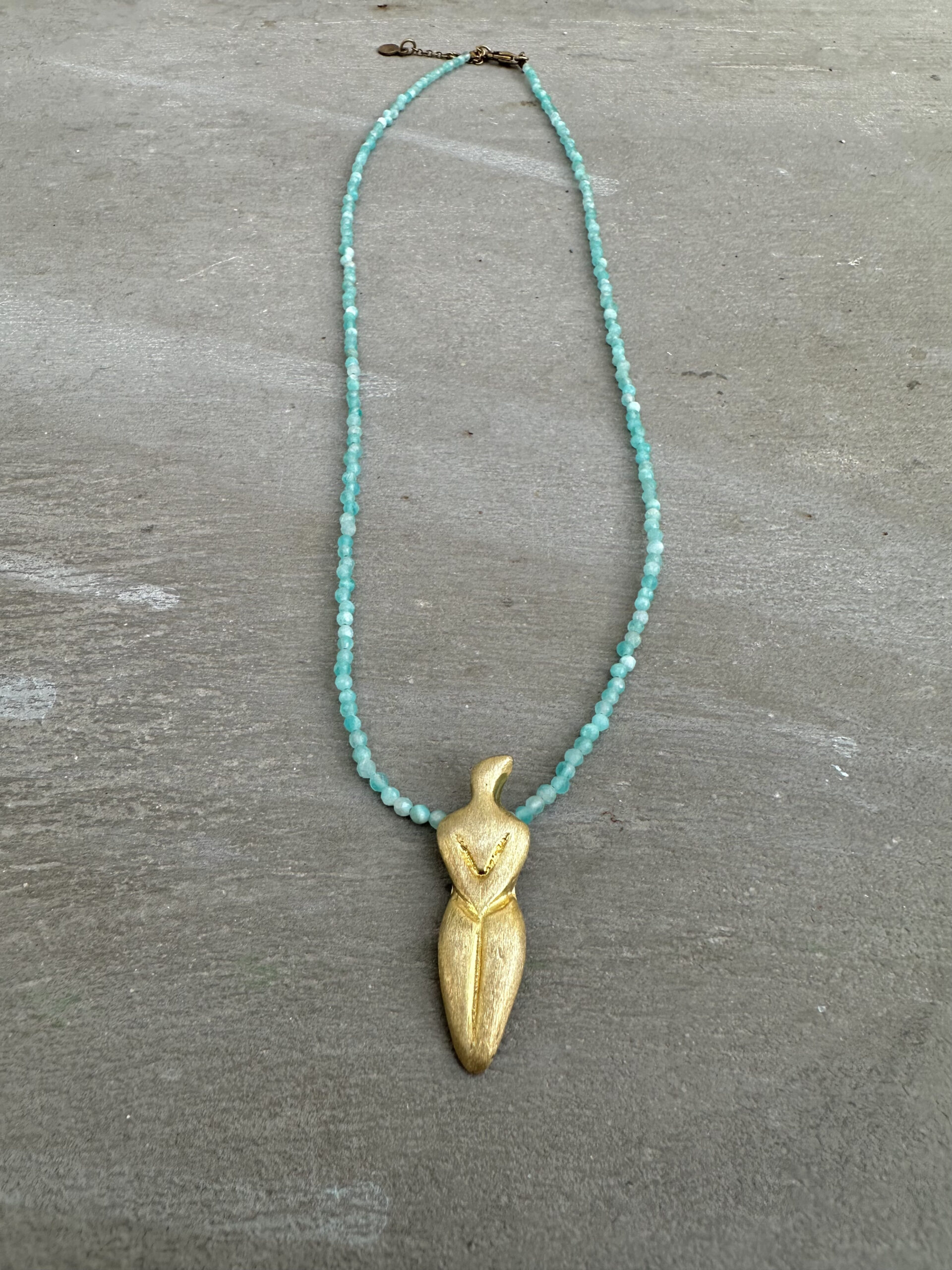
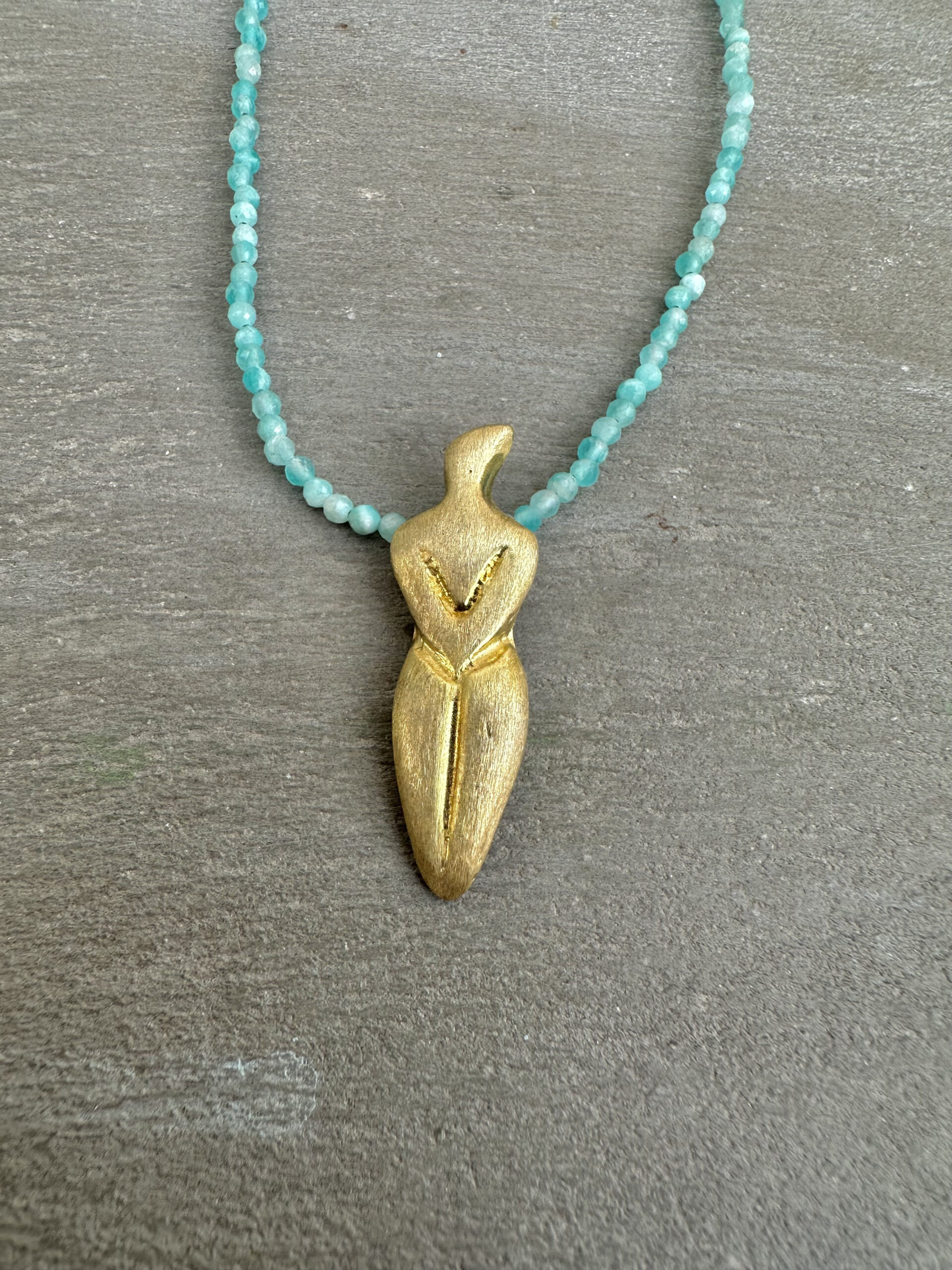
Cycladic pendant Neckace

160,00 

this necklace is has a Cycladic pendant from silver gold plated

and the necklace is made with amazonite beads in a metal wire

the clip is also silver gold plated

please avoid to wear them in the water and with perfume so that the gold plate wont be affected

The ancient Cycladic culture flourished in the islands of the Aegean Sea from c. 3300 to 1100 BCE.[1] Along with the Minoan civilization and Mycenaean Greece, the Cycladic people are counted among the three major Aegean cultures. Cycladic art therefore comprises one of the three main branches of Aegean art.

The best known type of artwork that has survived is the marble figurine, most commonly a single full-length female figure with arms folded across the front. The type is known to archaeologists as a “FAF” for “folded-arm figure(ine)”. Apart from a sharply-defined nose, the faces are a smooth blank, although there is evidence on some that they were originally painted. Considerable numbers of these are known, although most were removed illicitly from their unrecorded archaeological context, which seems usually to be a burial.

Description

The ancient Cycladic culture flourished in the islands of the Aegean Sea from c. 3300 to 1100 BCE.[1] Along with the Minoan civilization and Mycenaean Greece, the Cycladic people are counted among the three major Aegean cultures. Cycladic art therefore comprises one of the three main branches of Aegean art.

The best known type of artwork that has survived is the marble figurine, most commonly a single full-length female figure with arms folded across the front. The type is known to archaeologists as a “FAF” for “folded-arm figure(ine)”. Apart from a sharply-defined nose, the faces are a smooth blank, although there is evidence on some that they were originally painted. Considerable numbers of these are known, although most were removed illicitly from their unrecorded archaeological context, which seems usually to be a burial.